Stop by the African-American Environmentalist Association for details. For more, click here.
Technorati tags: EPA, Environment, Technology, Radioactive Waste Disposal
Friday, 31 March 2006
Another Blogger for Nuclear Energy
Say Goodbye to Earth Sentinel. Say hello to greenr.
Technorati tags: Nuclear Energy, Nuclear Power, Electricity, Environment, Energy
Technorati tags: Nuclear Energy, Nuclear Power, Electricity, Environment, Energy
Thursday, 30 March 2006
Another Blogger For Nuclear Energy
Meet Kinshasa on the Potomac. Visit Chris Iddon too.
Technorati tags: Nuclear Energy, Nuclear Power, Electricity, Environment, Energy
Technorati tags: Nuclear Energy, Nuclear Power, Electricity, Environment, Energy
Fighting Back With Online Video
Back in January, we told you about a ridiculous video created by Greenpeace U.K. of an airliner crashing into a seaside nuclear power plant while a terrified family looks on (watch it here). More recently, I discovered a video by the Committee to Bridge the Gap on the same topic narrated by noted corporate security expert, Martin Sheen (he's like a bad penny).
Both videos leverage services from an online service called YouTube, a Web site that allows members to upload video for free. In turn, the videos can either be viewed over at YouTube, or alternately, embedded in your own Website inside a video player (we used it here). It's a great service, and one that NEI's members ought to be using to get their message out to a wider audience.
So, in the interest of equal time, NEI recently uploaded our own nuclear security video over at a competing service, Google Video. Watch it right now:
And while our narrator isn't a television actor, we like to think he's a little better informed. We've got about 10 other videos uploaded, and we'll be featuring them all in the ensuing weeks and months. And if you have an industry-related video you'd like to share, send it my way, and we'll feature it at NEI Nuclear Notes.
POSTSCRIPT: One last item: Both YouTube and Google Video are great tools, and we intend to use them both. You should too.
Technorati tags: Nuclear Energy, Nuclear Power, Environment, Energy, Politics, Technology, Economics, United Kingdom, Greenpeace, Martin Sheen, Committee to Bridge the Gap, Security
Both videos leverage services from an online service called YouTube, a Web site that allows members to upload video for free. In turn, the videos can either be viewed over at YouTube, or alternately, embedded in your own Website inside a video player (we used it here). It's a great service, and one that NEI's members ought to be using to get their message out to a wider audience.
So, in the interest of equal time, NEI recently uploaded our own nuclear security video over at a competing service, Google Video. Watch it right now:
And while our narrator isn't a television actor, we like to think he's a little better informed. We've got about 10 other videos uploaded, and we'll be featuring them all in the ensuing weeks and months. And if you have an industry-related video you'd like to share, send it my way, and we'll feature it at NEI Nuclear Notes.
POSTSCRIPT: One last item: Both YouTube and Google Video are great tools, and we intend to use them both. You should too.
Technorati tags: Nuclear Energy, Nuclear Power, Environment, Energy, Politics, Technology, Economics, United Kingdom, Greenpeace, Martin Sheen, Committee to Bridge the Gap, Security
Skip Bowman on Global Nuclear Build
Earlier this week in Brussels at ENA 2006, NEI CEO Skip Bowman laid out five key points critical to the future of the industry. Here's #3:
Technorati tags: Nuclear Energy, Nuclear Power, Used Fuel, Energy, Reprocessing, Technology, Electricity, Yucca Mountain
Point No. 3: To build sustainable confidence in nuclear energy in the United States, we are defining a long-term road map and vision.Note that last paragraph. Read it again, and understand that whatever progress we may make toward an integrated international program to recycle used nuclear fuel, it will not obviate the need for a national used fuel repository.
For sure in the near-term: A new construction cycle for advanced light water reactors, well-suited for baseload electricity production.
Possibly in the medium-term: Starting around 2025, commercial deployment of high-temperature reactors, with a more varied product slate, using advanced hydrogen production technologies, co-located with oil refineries and coal gasification plants, providing hydrogen they require to upgrade coal and the heavy crude oils of the future into usable products. Generating process heat to produce clean drinking water, to extract oil from tar sands and other industrial applications.
And the long-term vision: Over the next 30 to 40 years, deployment of advanced technologies to partition used fuel to recover the uranium and plutonium and recycle them, recycle long-lived minor actinides into fuel, deploy fast-spectrum reactors capable of burning actinides.
Technorati tags: Nuclear Energy, Nuclear Power, Used Fuel, Energy, Reprocessing, Technology, Electricity, Yucca Mountain
Wednesday, 29 March 2006
NEI Energy Markets Report (March 20th - 24th)
Here's a summary of what went on in the energy markets last week:
Technorati tags: Nuclear Energy, Nuclear Power, Electricity, Environment, Energy, Natural Gas, Coal, Oil
For the report click here (pdf). It is also located on NEI's Nuclear Statistics webpage.Electricity prices mostly increased in the East and Midwest but fell in the West (see pages 1 & 2).
Gas prices at the Henry Hub rose $0.26 to $7.10/MMBtu (see page 4). Oil prices at the West Texas Intermediate were $62.64/barrel for the week of March 13th – 18th (see page 5).
Nuclear capacity availability was at 82% last week. Fourteen units were in refueling outages (see pages 2 & 3).
Technorati tags: Nuclear Energy, Nuclear Power, Electricity, Environment, Energy, Natural Gas, Coal, Oil
NAM: Time for America to Emulate French Nuclear Program
In the wake of yesterday's front page story in the Wall Street Journal on the French commercial nuclear energy program, Pat Cleary over at the NAM Blog had this to say:
Technorati tags: Nuclear Energy, Nuclear Power, Electricity, Environment, Energy, France, Manufacturing
Here in the US, it's a different story. We remain hamstrung by some pretty lousy policy choices we've made on energy. The enviros have all but achieved a moratorium on nuclear plants here. They don't want us to drill for oil, or for natural gas, or to mine -- or burn -- coal either, by the way. And so we sit and watch our energy prices soar while our competitors can only look at us and scratch their heads. We are the only country that restricts access to its own natural resources. Who else among our competitors would be dumb enough to do that?Not China, Japan, Korea or Taiwan, that's for sure.
Technorati tags: Nuclear Energy, Nuclear Power, Electricity, Environment, Energy, France, Manufacturing
Tuesday, 28 March 2006
North Anna ESP update
Yesterday I was fortunate enough to hear a presentation by Gene Grecheck of Dominion. He discussed progress on the North Anna early site permit (ESP) process. That’s a subject that dates back to some of the earliest days of this blog. Since the presentation ran for a full hour, I won’t try to repeat it here, but a couple of points seemed to be of particularly broad interest.
The first point was about how we in the industry continue to wait impatiently for a new plant order. On a personal note, I would like to observe that it’s funny how our perspectives change. Five years ago, we were thrilled when anyone would say "nuclear" in a context that was not pejorative. One year ago, we were thrilled to hear that Duke was going to pursue a construction and operating license. Now, we really want to hear about a contract to build a new plant. In a few years, even that won’t satisfy us, and we will want to hear about concrete pours.
But I digress. Gene did not discuss changes in perspective, but he did mention that some nuclear engineering professors had asked him why new plant orders were so slow in coming. Students of licensing will know the answer. The new licensing process (10 CFR 52) has numerous highly visible steps that can precede the actual order. In the old process (10 CFR 50), the early steps were not nearly so visible. (See slides 12-14 of this PowerPoint presentation on the NEI Web site for a visual comparison of the old and new processes.) Utilities, Gene explained, are taking the process one step at a time, as well they should.
The second point is that the step-by-step licensing process worked for Dominion. Those familiar with the North Anna ESP will know that cooling water has long been a bone of contention. Gene cleared up the history of that issue for me. Lake Anna was originally designed for four 800-MW (electric) units. After the Nuclear Regulatory Commission approved the construction permit, Congress passed the Clean Water Act, which gave the states the authority to regulate water use. The Virginia Department of Environmental Quality classifies evaporative cooling as consumptive water use, and it saw an additional reactor (with evaporative cooling) as imposing an excessive demand on the Pamunkey River. Dominion accordingly modified its ESP application so that a new reactor would use a wet/dry cooling system, even though adding a third reactor at North Anna would not impose a water demand that exceeds what the NRC had approved. The ESP process identified a problem (water supply) and required that it be solved at an early date. Although there was some schedule slippage, there was substantial benefit in that Dominion was able to solve the problem without costly backfits.
The first point was about how we in the industry continue to wait impatiently for a new plant order. On a personal note, I would like to observe that it’s funny how our perspectives change. Five years ago, we were thrilled when anyone would say "nuclear" in a context that was not pejorative. One year ago, we were thrilled to hear that Duke was going to pursue a construction and operating license. Now, we really want to hear about a contract to build a new plant. In a few years, even that won’t satisfy us, and we will want to hear about concrete pours.
But I digress. Gene did not discuss changes in perspective, but he did mention that some nuclear engineering professors had asked him why new plant orders were so slow in coming. Students of licensing will know the answer. The new licensing process (10 CFR 52) has numerous highly visible steps that can precede the actual order. In the old process (10 CFR 50), the early steps were not nearly so visible. (See slides 12-14 of this PowerPoint presentation on the NEI Web site for a visual comparison of the old and new processes.) Utilities, Gene explained, are taking the process one step at a time, as well they should.
The second point is that the step-by-step licensing process worked for Dominion. Those familiar with the North Anna ESP will know that cooling water has long been a bone of contention. Gene cleared up the history of that issue for me. Lake Anna was originally designed for four 800-MW (electric) units. After the Nuclear Regulatory Commission approved the construction permit, Congress passed the Clean Water Act, which gave the states the authority to regulate water use. The Virginia Department of Environmental Quality classifies evaporative cooling as consumptive water use, and it saw an additional reactor (with evaporative cooling) as imposing an excessive demand on the Pamunkey River. Dominion accordingly modified its ESP application so that a new reactor would use a wet/dry cooling system, even though adding a third reactor at North Anna would not impose a water demand that exceeds what the NRC had approved. The ESP process identified a problem (water supply) and required that it be solved at an early date. Although there was some schedule slippage, there was substantial benefit in that Dominion was able to solve the problem without costly backfits.
Progress Energy Calls for National Climate Change Policy
Progress Energy today released its report on global climate change, saying that there is enough understanding of the issue to warrant action by the private and public sectors. The company also called for the development of a national climate change policy, which it says should include nuclear power.
Click here to read the press release, and here to read the full report.
Technorati tags: Nuclear Energy, Nuclear Power, Environment, Energy, Politics, Technology, Economics, Progress Energy, Climate Change
"Progress Energy recognizes the importance, scale and complexity of global climate change," said Bob McGehee, chairman and chief executive officer. "Addressing this issue and other environmental challenges will require a balanced solution, including more conservation and efficiency programs, clean coal and nuclear generation, and the development and use of advanced and renewable technologies."Progress informed the Nuclear Regulatory Commission in August 2005 that it plans to submit a combined construction and operating license for a new nuclear plant. It updated those plans in November 2005 to include a second application - one for the Harris Nuclear Plant site in North Carolina and one for Florida at a site still to be determined. Each application covers up to two reactors at each site.
Click here to read the press release, and here to read the full report.
Technorati tags: Nuclear Energy, Nuclear Power, Environment, Energy, Politics, Technology, Economics, Progress Energy, Climate Change
Senate Confirms Spurgeon as DOE Assistant Secretary
The Senate voted 88-0 yesterday to approve the nomination of Dennis Spurgeon as the Department of Energy’s assistant secretary for nuclear energy, a new position created by the Energy Policy Act of 2005.
Spurgeon is a former executive vice president and chief operating officer of USEC Inc.
UPDATE: Here's what NEI Senior Vice President of Governmental Affairs Alex Flint had to say today about Spurgeon's confirmation:
Technorati tags: Nuclear Energy, Nuclear Power, Environment, Energy, Politics, Technology, Economics, Department of Energy, Spurgeon
Spurgeon is a former executive vice president and chief operating officer of USEC Inc.
UPDATE: Here's what NEI Senior Vice President of Governmental Affairs Alex Flint had to say today about Spurgeon's confirmation:
“Assistant Secretary Spurgeon has a wealth of knowledge on energy issues generally and on nuclear energy specifically. His leadership in the Office of Nuclear Energy will be tremendously beneficial to [DOE] as it seeks to implement the president’s Advanced Energy Initiative and strengthen U.S. energy security.”Read NEI's full news release here.
Technorati tags: Nuclear Energy, Nuclear Power, Environment, Energy, Politics, Technology, Economics, Department of Energy, Spurgeon
'Team CANDU' Created to Build Nuclear Plants in Ontario
Five nuclear technology and engineering companies have joined together on “Team CANDU,” a four-year agreement to build new nuclear power plants in Ontario.
The five companies are:
- Atomic Energy of Canada Ltd.
- Babcock & Wilcox Canada
- General Electric Canada
- Hitachi Canada Ltd.
- SNC Lavalin Nuclear Inc.
They have partnered to devise a business model for fixed-price, turnkey plants, or plants that will be built ready to operate.
The formation of Team CANDU comes after a December 2005 report by the Ontario Power Authority stated that two-thirds of Ontario’s baseload generation will need to be replaced in the next 15 years.
Technorati tags: Nuclear Energy, Nuclear Power, Environment, Energy, Politics, Technology, Economics, Ontario
The five companies are:
- Atomic Energy of Canada Ltd.
- Babcock & Wilcox Canada
- General Electric Canada
- Hitachi Canada Ltd.
- SNC Lavalin Nuclear Inc.
They have partnered to devise a business model for fixed-price, turnkey plants, or plants that will be built ready to operate.
The formation of Team CANDU comes after a December 2005 report by the Ontario Power Authority stated that two-thirds of Ontario’s baseload generation will need to be replaced in the next 15 years.
Technorati tags: Nuclear Energy, Nuclear Power, Environment, Energy, Politics, Technology, Economics, Ontario
Monday, 27 March 2006
State Legislatures Support New Nuclear Build
So many states have been busy passing resolutions or legislation to support new nuclear plant construction that it might just be time for a roundup of all the activity. The bills and resolutions address the sharp increase in energy demand and consumption expected in the United States in the coming decades. They also recognize the need for increased energy independence; new-build incentives in the Energy Policy Act of 2005; and nuclear energy’s safety, reliability and clean-air attributes.
The South Dakota legislature passed a resolution (1010) Feb. 27 supporting the development of nuclear power in the state. It encourages U.S. academic institutions to pursue research in developing nuclear energy, and is similar to a bill, signed into law March 3, to examine the feasibility of new nuclear generation in the state.
Another resolution (865), passed by a large majority of the Georgia State Senate in March, urges electric utilities to conduct a feasibility study for building new nuclear power plants in the state. The resolution cites the price volatility of natural gas—which fuels the large majority of power plants built in Georgia in the last 15 years—as a reason not only to consider new nuclear build, but also to maintain the state’s current share (about 27 percent) of nuclear generation.
Virginia’s proposed comprehensive 10-year energy plan (SB 262), passed by both houses, directs the State Corporation Commission to evaluate different land areas for their suitability as future sites of nuclear, wind energy, liquefied natural gas and solar energy facilities. The four reactors at the existing Surry and North Anna nuclear plants, however, are exempt from this process.
The Florida Energy Diversity and Efficiency Act (S 2494), now under consideration in both houses, proposes a “centrally coordinated permitting process” to support new reactors in the state. It also would define the process for expanding generating capacity at existing nuclear plants in the state.
Out West, the governor of Utah signed a bill (H.B. 46) in March that promotes the study of nuclear power generation.
The legislature in South Carolina is considering a bill (S 1238) encouraging construction of a new nuclear reactor at the single-reactor V.C. Summer plant, of which the South Carolina Public Service Authority and South Carolina Electric and Gas Co. share ownership.
And finally, a bill (HB 2904) is moving through the Kansas House of Representatives that would provide a property tax exemption for a new or expanded nuclear generation facility.
Technorati tags: Nuclear Energy, Nuclear Power, Environment, Energy, Politics, Technology, Economics
The South Dakota legislature passed a resolution (1010) Feb. 27 supporting the development of nuclear power in the state. It encourages U.S. academic institutions to pursue research in developing nuclear energy, and is similar to a bill, signed into law March 3, to examine the feasibility of new nuclear generation in the state.
Another resolution (865), passed by a large majority of the Georgia State Senate in March, urges electric utilities to conduct a feasibility study for building new nuclear power plants in the state. The resolution cites the price volatility of natural gas—which fuels the large majority of power plants built in Georgia in the last 15 years—as a reason not only to consider new nuclear build, but also to maintain the state’s current share (about 27 percent) of nuclear generation.
Virginia’s proposed comprehensive 10-year energy plan (SB 262), passed by both houses, directs the State Corporation Commission to evaluate different land areas for their suitability as future sites of nuclear, wind energy, liquefied natural gas and solar energy facilities. The four reactors at the existing Surry and North Anna nuclear plants, however, are exempt from this process.
The Florida Energy Diversity and Efficiency Act (S 2494), now under consideration in both houses, proposes a “centrally coordinated permitting process” to support new reactors in the state. It also would define the process for expanding generating capacity at existing nuclear plants in the state.
Out West, the governor of Utah signed a bill (H.B. 46) in March that promotes the study of nuclear power generation.
The legislature in South Carolina is considering a bill (S 1238) encouraging construction of a new nuclear reactor at the single-reactor V.C. Summer plant, of which the South Carolina Public Service Authority and South Carolina Electric and Gas Co. share ownership.
And finally, a bill (HB 2904) is moving through the Kansas House of Representatives that would provide a property tax exemption for a new or expanded nuclear generation facility.
Technorati tags: Nuclear Energy, Nuclear Power, Environment, Energy, Politics, Technology, Economics
Nuclear Energy Industry Transitions
Mike Coyle is Exelon Nuclear’s new vice president of mid-Atlantic operations. He previously served as NEI’s vice president of operations.
Progress Energy has announced several management changes. Jeffrey Lyash will be president and CEO of Progress Energy Florida, effective June 1. He will replace the retiring H. William Habermeyer Jr. Don Davis, executive vice president of diversified operations, will retire April 14. Paula Sims, currently vice president of fossil generation, will replace Davis and senior vice president. Charlie Gates, coal-fired power plant manager in the Carolinas and general manager of Progress Energy’s three fossil plant regions, will replace Sims.
The Nuclear Regulatory Commission has named J. Sam Armijo, Ph.D., to its Advisory Committee on Reactor Safeguards. Armijo is an adjunct professor of materials science and engineering at the University of Nevada, Reno.
Alexander “Andy” Karsner has been sworn in as the Department of Energy’s assistant secretary of energy efficiency and renewable energy. He had been confirmed March 16 by unanimous consent of the Senate. Karsner joins DOE from Enercorp LLC, where he was managing director.
Russia’s Rosenergoatom has named Sergei Alexandrovich Obozov its acting director general and Alexander Markovich Lokshin first deputy director general. Stanislav Ivanovich Antipov has been appointed adviser.
Technorati tags: Nuclear Energy, Nuclear Power, Environment, Energy, Politics, Technology, Economics
Progress Energy has announced several management changes. Jeffrey Lyash will be president and CEO of Progress Energy Florida, effective June 1. He will replace the retiring H. William Habermeyer Jr. Don Davis, executive vice president of diversified operations, will retire April 14. Paula Sims, currently vice president of fossil generation, will replace Davis and senior vice president. Charlie Gates, coal-fired power plant manager in the Carolinas and general manager of Progress Energy’s three fossil plant regions, will replace Sims.
The Nuclear Regulatory Commission has named J. Sam Armijo, Ph.D., to its Advisory Committee on Reactor Safeguards. Armijo is an adjunct professor of materials science and engineering at the University of Nevada, Reno.
Alexander “Andy” Karsner has been sworn in as the Department of Energy’s assistant secretary of energy efficiency and renewable energy. He had been confirmed March 16 by unanimous consent of the Senate. Karsner joins DOE from Enercorp LLC, where he was managing director.
Russia’s Rosenergoatom has named Sergei Alexandrovich Obozov its acting director general and Alexander Markovich Lokshin first deputy director general. Stanislav Ivanovich Antipov has been appointed adviser.
Technorati tags: Nuclear Energy, Nuclear Power, Environment, Energy, Politics, Technology, Economics
Another Blogger for Nuclear Energy
Meet elderrant.
Technorati tags: Nuclear Energy, Nuclear Power, Electricity, Environment, Energy, Scotland
Technorati tags: Nuclear Energy, Nuclear Power, Electricity, Environment, Energy, Scotland
This Week on the Hill
House Energy and Water Appropriations: Hearing on fiscal 2007 appropriations for science research within the Department of Energy. March 29, 10 a.m. (2362-B Rayburn Building).
House Energy and Water Appropriations: Hearing on fiscal 2007 appropriations for energy supply and conservation within DOE. March 30, 10 a.m. (2362-B Rayburn Building).
Senate Appropriations Energy and Water Subcommittee: Hearing on fiscal 2007 appropriations for Yucca Mountain/Environmental Management/Office of Safeguards and Security. March 30, 10 a.m. (138 Dirksen Building).
Note: Committee Schedules are subject to change.
Technorati tags: Nuclear Energy, Nuclear Power, Environment, Energy, Politics, Technology, Economics
House Energy and Water Appropriations: Hearing on fiscal 2007 appropriations for energy supply and conservation within DOE. March 30, 10 a.m. (2362-B Rayburn Building).
Senate Appropriations Energy and Water Subcommittee: Hearing on fiscal 2007 appropriations for Yucca Mountain/Environmental Management/Office of Safeguards and Security. March 30, 10 a.m. (138 Dirksen Building).
Note: Committee Schedules are subject to change.
Technorati tags: Nuclear Energy, Nuclear Power, Environment, Energy, Politics, Technology, Economics
Friday, 24 March 2006
Some Notes on Tritium
There's been plenty of talk in our comment strings the past few weeks of the discovery of elevated levels of Tritium, a byproduct of nuclear power generation, in groundwater in and around a number of nuclear power plants.
Recently, NEI issued a fact sheet on the incidents that provides some perspective and insight into the science involved:
Nobody welcomes an incident like this, and officials in the companies involved are taking the lead in communicating the facts to the public. In the case of Exelon, the company is doing it door-to-door in the neighborhoods involved. And that's how it should be.
For information on the situation from the NRC, click here.
Technorati tags: Nuclear Energy, Nuclear Power, Environment, Energy
Recently, NEI issued a fact sheet on the incidents that provides some perspective and insight into the science involved:
For perspective, the amount of tritium in the groundwater at the nuclear power plant with the highest and most extensive levels of tritium is far less than the amount of tritium in a single 'exit' sign. Many industrial-grade exit signs contain 10 to 20 curies of tritium gas. By comparison, the average concentration of tritium in groundwater at nuclear plants is at or below the EPA standard for tritium in drinking water -- 0.02 microcuries per liter.To read what other blogs are saying about the situation, click here.
Nobody welcomes an incident like this, and officials in the companies involved are taking the lead in communicating the facts to the public. In the case of Exelon, the company is doing it door-to-door in the neighborhoods involved. And that's how it should be.
For information on the situation from the NRC, click here.
Technorati tags: Nuclear Energy, Nuclear Power, Environment, Energy
Nuclear Energy Insight
The latest issue of Nuclear Energy Insight is now available online. In it, you will find an article on near-record level of electricity production and reliability posted by U.S. nuclear power plants in 2005. There also are reports on a NASA spacecraft headed to Pluto powered by nuclear technology and “Energy Week” speeches by President Bush and Cabinet officials endorsing nuclear power as part of a secure, diverse energy portfolio. Other articles discuss a nuclear plant evacuation plan that serves as a model for Connecticut, a nuclear plant that reopened its visitor center to delight of public, and moves by state lawmakers to examine nuclear energy’s possibilities.
Technorati tags: Nuclear Energy, Nuclear Power, Environment, Energy, Politics, Technology, Economics
Technorati tags: Nuclear Energy, Nuclear Power, Environment, Energy, Politics, Technology, Economics
Keeping Up With the Anti-Nukes
Over on our blogroll to the right, you'll notice that we added a section on anti-nuclear activists. We think it's important to track these folks, which is why we're including them.
But rather than simply listing their links, we've added a new wrinkle: Whenever we have dealt with these groups in print before, I've included a link to our archives where you'll find detailed responses to their charges. Click here to see what we did with the Rocky Mountain Institute.
Technorati tags: Nuclear Energy, Nuclear Power, Electricity, Environment, Energy
But rather than simply listing their links, we've added a new wrinkle: Whenever we have dealt with these groups in print before, I've included a link to our archives where you'll find detailed responses to their charges. Click here to see what we did with the Rocky Mountain Institute.
Technorati tags: Nuclear Energy, Nuclear Power, Electricity, Environment, Energy
Thursday, 23 March 2006
China Counts the Cost of Coal
Earlier this week, we pointed to a story about how China is producing more coal than ever before. And it's important to remember that it comes with a cost. Here's AOL Vice Chairman Ted Leonsis on his visit to Shanghai:
Technorati tags: Nuclear Energy, Nuclear Power, Environment, Energy, Politics, Technology, Economics, China, Ted Leonsis
The city is remarkably clean, but the air is not. There is a cloud of pollution that hangs over the city and stings the eyes. And everywhere you look, at every time of the day, there are people, a seemingly endless stream of people buzzing about - talking, eating, shopping, and working.After a simply observation like that, it's easy to see why China wants to build so much new nuclear generating capacity.
Technorati tags: Nuclear Energy, Nuclear Power, Environment, Energy, Politics, Technology, Economics, China, Ted Leonsis
Stewart Brand to Address Nuclear Energy Assembly
I just spoke to my colleague Lisa Steward, and I can break the news that Stewart Brand, founder of the Whole Earth Catalog and author of the groundbreaking essay, Environmental Heresies, has agreed to address the 2006 Nuclear Energy Assembly in San Francisco on Friday, May 19.
Since Brand's essay appeared in MIT Technology Review last Spring, his name has become a familiar one for readers of NEI Nuclear Notes. Click here for our complete archive on Brand and all the dust he's been kicking up in the past year.
Technorati tags: Nuclear Energy, Nuclear Power, Environment, Energy, Politics, Technology, Economics
Since Brand's essay appeared in MIT Technology Review last Spring, his name has become a familiar one for readers of NEI Nuclear Notes. Click here for our complete archive on Brand and all the dust he's been kicking up in the past year.
Technorati tags: Nuclear Energy, Nuclear Power, Environment, Energy, Politics, Technology, Economics
Wednesday, 22 March 2006
Getting a Correction from MSNBC
Crossing a lot of our desks at NEI today is a profile of one of our newest employees, Alex Flint, who joined NEI as Vice President of Government Affairs earlier this year.
It's your typical revolving door ethics story, one where activist groups who try to conceal their own conflicts of interest try to slime a former public servant in the absence of any evidence.
In any case, this story has something of a happy ending. My colleague Steve Kerekes just told me that MSNBC reporter Mike Stuckey has agreed to update the story to reflect the fact that both U.S. PIRG and Public Citizen have a significant axe to grind with our industry.
Just another thing to keep in mind when you scan the headlines.
Technorati tags: Nuclear Energy, Nuclear Power, Energy, Electricity, Congress, Ethics
It's your typical revolving door ethics story, one where activist groups who try to conceal their own conflicts of interest try to slime a former public servant in the absence of any evidence.
Nobody alleges that Flint did anything illegal. Neither the law nor Senate rules prohibited Flint from leaving the Energy Committee post after three years in which he helped develop policy and shepherd legislation on nuclear issues and going directly to work as NEI’s senior vice president for governmental affairs.What the original story didn't disclose was the long and well documented history of both U.S. PIRG and Public Citizen as part of the vanguard of anti-nuclear activism (click here and here for just two examples). As we've seen before, while organizations like Public Citizen and U.S. PIRG demand transparency from their political enemies, they can't seem to live up to the same standards.
And one Washington watchdog says Flint's career path is hardly surprising in today's environment, where congressional staff jobs are viewed by many as a "stepping stone to riches."
Critics like Gary Kalman of the U.S. Public Interest Research Group say Flint's case is especially troubling in light of the fact that the Senate panel had recently finished work on legislation that included billions of dollars in research, construction and operating subsidies, and billions more in tax breaks for the well-heeled nuclear energy industry.
(Snip)
The Energy Policy Act of 2005 was a key focus of the committee’s work in Flint’s tenure as staff director. Its provisions, which became law when signed by President Bush last August, were labeled "The Best Energy Bill Corporations Could Buy" by Public Citizen and delighted the nuclear industry.
In any case, this story has something of a happy ending. My colleague Steve Kerekes just told me that MSNBC reporter Mike Stuckey has agreed to update the story to reflect the fact that both U.S. PIRG and Public Citizen have a significant axe to grind with our industry.
Just another thing to keep in mind when you scan the headlines.
Technorati tags: Nuclear Energy, Nuclear Power, Energy, Electricity, Congress, Ethics
NEI Energy Markets Report (March 13th - 17th)
Here's a summary of what went on in the energy markets last week:
Technorati tags: Nuclear Energy, Nuclear Power, Electricity, Environment, Energy, Natural Gas, Coal, Oil
Electricity prices mostly increased throughout the country (see pages 1 & 2). Gas prices at the Henry Hub rose $0.36 to $6.84/MMBtu (see page 4).For the report click here (pdf). It is also located on NEI's Nuclear Statistics webpage.
Nuclear capacity availability was at 85% last week. Twelve units were in refueling outages. LaSalle 1 completed a 26 day refueling outage and set a new world record for longest continuous run by a light water reactor at 739 days on February 20th. The previous record was held by Peach Bottom 3 at 708 days (see pages 2 & 3).
Technorati tags: Nuclear Energy, Nuclear Power, Electricity, Environment, Energy, Natural Gas, Coal, Oil
Tuesday, 21 March 2006
Monday, 20 March 2006
China to Set Coal Output Record
From the China Daily:
Technorati tags: Energy, Politics, China, Coal, Electricity
Top energy planners are seeking, in the next five years, to raise China's coal output to an unprecedented level and, at the same time, reduce the number of large mining disasters.China's coal output will be between 2.5 billion and 2.6 billion tons in 2010, as compared with 2.19 billion tons in 2005, according to Guo Yuntao, director of the China Development Research Centre for the Coal Industry, in an interview with China Daily.
The growth rate being forecast by the planning team led by Guo is much slower than in the last five years, when China's coal output rose from about 1.3 billion tons in 2000.
More from the Houston Chronicle.
Technorati tags: Energy, Politics, China, Coal, Electricity
Nuclear Energy Industry Transitions
TXU Corp. last week announced several leadership changes. Mike Childers is the new CEO of Generation Development. Chief Financial Officer Kirk Oliver and General Counsel Eric Peterson will be leaving TXU Corp. David Campbell, executive vice president of corporate planning, strategy and risk, will temporarily assume Oliver’s responsibilities. David Poole will be the company’s new general counsel and executive vice president of legal.
The Shaw Group has hired Dave Barry as president of the Shaw Stone & Webster Nuclear Services division. Barry joins Shaw from Bechtel, where he had been for six years, most recently as operations manager for fossil power projects.
PG&E Corp. has elected Richard Rollo as vice president of strategic development and business integration, effective March 29. Rollo joins PG&E from Health Net Inc., where he was vice president of corporate development and M&A.
Nebraska Public Power District (NPPD) has named Traci Bender its vice president of finance, risk management and rates, and its chief financial officer, effective immediately. Bender has been with NPPD since 1990, most recently in the position of corporate planning and risk manager. She succeeds Ron Asche, who was named NPPD’s president and CEO in February.
Bernard Estève has been appointed executive president of AREVA North America, effective April 1. Xavier Jacob will replace Estève as senior executive vice president of AREVA NP, Plants Sector. AREVA Inc. also appointed Philippe Hatron chief financial officer.
David Oatley, vice president and general manager of the Diablo Canyon nuclear plant, retired from Pacific Gas and Electric Co. March 13.
David McCarthy will be the House Energy and Commerce Committee’s new chief energy counsel, effective next month. He will succeed the departing Mark Menezes. McCarthy’s previously served as deputy commissioner of U.S. Bureau of Reclamation, overseeing the bureau’s implementation of the Energy Policy Act of 2005.
Technorati tags: Nuclear Energy, Nuclear Power, Environment, Energy, Politics, Technology, Economics
The Shaw Group has hired Dave Barry as president of the Shaw Stone & Webster Nuclear Services division. Barry joins Shaw from Bechtel, where he had been for six years, most recently as operations manager for fossil power projects.
PG&E Corp. has elected Richard Rollo as vice president of strategic development and business integration, effective March 29. Rollo joins PG&E from Health Net Inc., where he was vice president of corporate development and M&A.
Nebraska Public Power District (NPPD) has named Traci Bender its vice president of finance, risk management and rates, and its chief financial officer, effective immediately. Bender has been with NPPD since 1990, most recently in the position of corporate planning and risk manager. She succeeds Ron Asche, who was named NPPD’s president and CEO in February.
Bernard Estève has been appointed executive president of AREVA North America, effective April 1. Xavier Jacob will replace Estève as senior executive vice president of AREVA NP, Plants Sector. AREVA Inc. also appointed Philippe Hatron chief financial officer.
David Oatley, vice president and general manager of the Diablo Canyon nuclear plant, retired from Pacific Gas and Electric Co. March 13.
David McCarthy will be the House Energy and Commerce Committee’s new chief energy counsel, effective next month. He will succeed the departing Mark Menezes. McCarthy’s previously served as deputy commissioner of U.S. Bureau of Reclamation, overseeing the bureau’s implementation of the Energy Policy Act of 2005.
Technorati tags: Nuclear Energy, Nuclear Power, Environment, Energy, Politics, Technology, Economics
This Week on the Hill
Nothing to report this week, as Congress is in recess, but be sure to check back next Monday for a list of upcoming hearings.
Nuclear vs. Wind, Part II
Today, I'm posting the conclusion of my discussion with Dave Erickson from Re/Action on Climate Protection regarding the relative benefits of wind and nuclear energy. In my last post, I looked at why displacing all of America's coal generated electric capacity with wind wasn't practical or achieveable. To read Part I, click here.
Today, in Part II, I'm taking a closer look at the economics of wind and nuclear energy.
Cost of Wind vs Cost of Nuclear to Replace Coal
There are several points I would like to argue about Dave’s post: capacity factors, costs and new nuclear build. The sources Dave uses for his information are excellent. He cites the MIT Study on the Future of Nuclear Power and IEA’s Projected Costs of Generating Electricity.
Costs
Everyone who wants to pronounce nuclear as uneconomical always cites the MIT Study. The study, whose authors are in favor of nuclear, offered suggestions for how nuclear can overcome a number of well known challenges, including waste disposal, among others:
The IEA study provides cost data on generating technologies throughout the world. But once again, Dave cherry picks his data. He only focuses on costs in the U.S. while ignoring the cost figures from the rest of the world. The overall cost of nuclear in the U.S. falls in the more expensive range compared to other countries.
Wind, however, is the cheapest in the U.S. versus other wind facilities throughout the rest of the world. Yet when comparing the two at the same discount rate in the U.S., they are comparable.
Dave also assumes that nuclear’s investment costs are riskier than wind and will have a higher discount rate therefore concludes nuclear is “completely unnecessary and uneconomical.”
This claim has merit but after the industry and regulator get over the hurdles of building the first few plants, we believe the risk will be much lower and the construction and licensing of new plants will be far more routine and predictable.
I would like to point out that Germany’s costs, where wind is very popular, are twice the U.S. costs of wind (pg. 61 & 62 of the IEA study). What is the U.S. doing that its wind costs are so low compared to everyone else in the world? Subsidies?
In Dave’s “Replace Coal with Wind” blog, to replace the current generation of coal with wind would require 120,000, 5 megawatt wind turbines which would cost a total of $610 Billion.
Do you know how much it would cost for nuclear to replace coal? $502 Billion. If you assume a 1,000 MW nuke plant will cost $2 Billion (a very conservative estimate) and you would need about 250 nuke plants to replace all of the generation from coal.
It doesn’t appear wind power is more “cost-effective than using nuclear.”
Capacity Factors
New Nuclear Build
Building a nuclear plant is about a ten year process: 4-5 years for the licensing process and another 4-5 years for actual construction. It’s a long time but the benefits are worth it: 60 years of clean, affordable and reliable electricity.
In my mind, Dave makes the same mistake a number of environmentalists make when it comes to comparing power sources: They continually set up a false choice. Our energy options are continually cast as a fight between one source and another, when the plain fact remains that future electricity demand will be so great, that no one type of generating capacity would be able to provide all the electricity we'll need on its own.
Sure, we live in a competitive environment where generating capacity needs to be economical. But the world also needs a diverse fuel mix in order to support security of supply.
Technorati tags: Nuclear Energy, Nuclear Power, Energy, Electricity, Environment, Wind Power
Today, in Part II, I'm taking a closer look at the economics of wind and nuclear energy.
Cost of Wind vs Cost of Nuclear to Replace Coal
There are several points I would like to argue about Dave’s post: capacity factors, costs and new nuclear build. The sources Dave uses for his information are excellent. He cites the MIT Study on the Future of Nuclear Power and IEA’s Projected Costs of Generating Electricity.
Costs
Everyone who wants to pronounce nuclear as uneconomical always cites the MIT Study. The study, whose authors are in favor of nuclear, offered suggestions for how nuclear can overcome a number of well known challenges, including waste disposal, among others:
We decided to study the future of nuclear power because we believe this technology, despite the challenges it faces, is an important option for the United States and the world to meet future energy needs without emitting carbon dioxide (CO2) and other atmospheric pollutants. (first sentence in Forward and Acknowledgements)In his own post, Dave cherry picks from the MIT study:
In deregulated markets, nuclear power is not now cost competitive with coal and natural gas.That seems definitive enough, doesn't it? Unfortunately, the study assumed natural gas prices to be between $3.50 - $4.50 / MMBtu. Prices are twice that. And this doesn't even begin to take possible carbon caps into account -- something many utilities see as inevitable.
The IEA study provides cost data on generating technologies throughout the world. But once again, Dave cherry picks his data. He only focuses on costs in the U.S. while ignoring the cost figures from the rest of the world. The overall cost of nuclear in the U.S. falls in the more expensive range compared to other countries.
Wind, however, is the cheapest in the U.S. versus other wind facilities throughout the rest of the world. Yet when comparing the two at the same discount rate in the U.S., they are comparable.
Dave also assumes that nuclear’s investment costs are riskier than wind and will have a higher discount rate therefore concludes nuclear is “completely unnecessary and uneconomical.”
This claim has merit but after the industry and regulator get over the hurdles of building the first few plants, we believe the risk will be much lower and the construction and licensing of new plants will be far more routine and predictable.
I would like to point out that Germany’s costs, where wind is very popular, are twice the U.S. costs of wind (pg. 61 & 62 of the IEA study). What is the U.S. doing that its wind costs are so low compared to everyone else in the world? Subsidies?
In Dave’s “Replace Coal with Wind” blog, to replace the current generation of coal with wind would require 120,000, 5 megawatt wind turbines which would cost a total of $610 Billion.
Do you know how much it would cost for nuclear to replace coal? $502 Billion. If you assume a 1,000 MW nuke plant will cost $2 Billion (a very conservative estimate) and you would need about 250 nuke plants to replace all of the generation from coal.
It doesn’t appear wind power is more “cost-effective than using nuclear.”
Capacity Factors
It justifies the capacity factor by saying that the 90% CF cited by David (me) has only recently been achieved by U.S. plants, and represents a peak. 75%-85% is more in line with actual plants over their operating lifetime.The 90% CF is not a peak, it’s not going to fall and in fact EIA projects in 2030 the CF will be 91%-92%. Most of the fleet has about a 75%-85% lifetime capacity factor like Dave noted. But the latest plant to come online in the U.S., Watts Bar 1 (1996), has a 91.3% lifetime CF. Any new nuclear plant built in the U.S. will have a CF that high. We've gained much experience running nuclear plants over the past 40 years.
New Nuclear Build
In fact, there are currently no new nuclear power plants being planned in the U.S., in spite of so-called “incentives” built into the 2005 EPACT.Building a new nuclear plant is a 10 step process. Dave is talking about step 5 and right now we’re on step 2. Nine companies have announced intentions of submitting applications for a Combined Construction and Operating License to the Nuclear Regulatory Commission to build between 14 and 20 new nuclear plants. One COL allows up to two nuclear reactors to be built.
Building a nuclear plant is about a ten year process: 4-5 years for the licensing process and another 4-5 years for actual construction. It’s a long time but the benefits are worth it: 60 years of clean, affordable and reliable electricity.
In my mind, Dave makes the same mistake a number of environmentalists make when it comes to comparing power sources: They continually set up a false choice. Our energy options are continually cast as a fight between one source and another, when the plain fact remains that future electricity demand will be so great, that no one type of generating capacity would be able to provide all the electricity we'll need on its own.
Sure, we live in a competitive environment where generating capacity needs to be economical. But the world also needs a diverse fuel mix in order to support security of supply.
Technorati tags: Nuclear Energy, Nuclear Power, Energy, Electricity, Environment, Wind Power
Friday, 17 March 2006
Nuclear vs. Wind, Part I
Over the past few weeks I have been engaged in a discussion over the benefits of wind and nuclear with Dave Erickson at Re/Action on Climate Protection. Two of his recent posts, Replace coal with Wind and Cost of Wind vs. Cost of Nuclear to Replace Coal, deserve further discussion.
Dave argues that wind is more cost effective than nuclear. However, his post is about climate protection and he never mentions that nuclear power is the leading source of emission free electricity in the U.S. Nuclear plants already avoid almost 700 million metric tons of CO2 annually in the U.S., and more than 2 billion metric tons of CO2 annually worldwide.
Replace Coal with Wind? Probably not. The U.S. has the largest reserves of coal in the world. Replacing coal completely with wind simply doesn't make economic sense. While coal releases significant emissions, it is getting cleaner. Any new coal plant built has to meet many stringent air requirements. To comply, coal plants are fitted with scrubbers and flue gas desulphurization emission technologies as well as other emission control techniques.
While replacing coal with wind could be beneficial for our air, I asked Dave how much land would be required. I noted that just to replace all the nuclear plants in the U.S. with wind, we would need an area the size of the state of Wisconsin. Dave contends that if wind turbines were packed closely together, to replace all of coal we'd only need an area equivalent to the size of West Virginia.
But think -- is it realistic enough land would be available? We’re talking about areas the size of states. Sure, there’s plenty of land in the Dakotas, Oklahoma, Nebraska and Kansas, but the vast majority of future electricity demand will be somewhere else. What good would that do? What about offshore wind? Possibly, if everyone doesn’t mind looking out at the ocean and viewing a horizon of turbines. As we've seen, Americans are picky about our scenery.
I'll have more on Monday when we post Part II of my analysis.
Technorati tags: Nuclear Energy, Nuclear Power, Energy, Electricity, Environment, Cape Cod, Wind Power, New England, Riverkeeper, NIMBY
Dave argues that wind is more cost effective than nuclear. However, his post is about climate protection and he never mentions that nuclear power is the leading source of emission free electricity in the U.S. Nuclear plants already avoid almost 700 million metric tons of CO2 annually in the U.S., and more than 2 billion metric tons of CO2 annually worldwide.
Replace Coal with Wind? Probably not. The U.S. has the largest reserves of coal in the world. Replacing coal completely with wind simply doesn't make economic sense. While coal releases significant emissions, it is getting cleaner. Any new coal plant built has to meet many stringent air requirements. To comply, coal plants are fitted with scrubbers and flue gas desulphurization emission technologies as well as other emission control techniques.
While replacing coal with wind could be beneficial for our air, I asked Dave how much land would be required. I noted that just to replace all the nuclear plants in the U.S. with wind, we would need an area the size of the state of Wisconsin. Dave contends that if wind turbines were packed closely together, to replace all of coal we'd only need an area equivalent to the size of West Virginia.

But think -- is it realistic enough land would be available? We’re talking about areas the size of states. Sure, there’s plenty of land in the Dakotas, Oklahoma, Nebraska and Kansas, but the vast majority of future electricity demand will be somewhere else. What good would that do? What about offshore wind? Possibly, if everyone doesn’t mind looking out at the ocean and viewing a horizon of turbines. As we've seen, Americans are picky about our scenery.
I'll have more on Monday when we post Part II of my analysis.
Technorati tags: Nuclear Energy, Nuclear Power, Energy, Electricity, Environment, Cape Cod, Wind Power, New England, Riverkeeper, NIMBY
Court Rules Against Bush Administration on New Source Review
From Greenwire (subscription required):
UPDATE: More from the Washington Post:
Technorati tags: Electricity, Energy, Politics, Coal, Environment, New Source Review, Technology
One of U.S. EPA's most controversial overhauls to the Clean Air Act program was deemed illegal today by a federal appeals court.This is huge. More later.
A three-judge panel from the U.S. Circuit Court of Appeals for the District of Columbia unanimously rejected EPA's changes to the New Source Review program. Judge Judith Rogers, lead author of the 20-page opinion, said EPA's August 2003 rule changes violated the air pollution law.
The ruling is a major victory for New York Attorney General Eliot Spitzer (D) and the coalition of states, large and small cities and environmentalists that has opposed the Bush administration's air pollution policies. The groups sued EPA immediately after it completed the rules, and they scored an early victory in December 2003 when the court issued a temporary injunction that halted their implementation.
UPDATE: More from the Washington Post:
Scott H. Segal, a spokesman for a Washington-based coalition of power companies called the Electric Reliability Coordinating Council, called the decision "a step backward in the protection of air quality in the United States," AP reported. According to the group's Web site, the Clean Air Act requirement in question "is threatening the reliability of our national electrical system and unnecessarily increasing the cost of power to American consumers and businesses, while providing no additional protection to the environment."We'll be keeping an eye on this.
The states that sued the EPA over the proposed rule change were New York, California, Connecticut, Delaware, Illinois, Maine, Maryland, Massachusetts, New Hampshire, New Jersey, New Mexico, Pennsylvania, Rhode Island, Vermont and Wisconsin. Backing them were officials representing the cities of Washington, D.C., New York and San Francisco.
Technorati tags: Electricity, Energy, Politics, Coal, Environment, New Source Review, Technology
Thursday, 16 March 2006
NEI Turns 12
On this day in 1994, the marriage of the U. S. Council for Energy Awareness, the Nuclear Management and Resources Council, Inc., the American Nuclear Energy Council, and the Nuclear Division of the Edison Electric Institute resulted in the creation of the Nuclear Energy Institute.
To all NEI employees, past and present, happy anniversary.
Technorati tags: Nuclear Energy, Nuclear Power, Electricity, Environment, Energy, Politics
To all NEI employees, past and present, happy anniversary.
Technorati tags: Nuclear Energy, Nuclear Power, Electricity, Environment, Energy, Politics
Duke, Southern Company Announce Joint Project
From the Charlotte Business Journal:
Technorati tags: Nuclear Energy, Nuclear Power, Electricity, Environment, Energy, Politics, Duke Power, Southern Company
Duke Power has chosen 2,022 acres near Gaffney, S.C., as the site for a proposed $6 billion, two-reactor nuclear plant, with rival Southern Co. of Atlanta to be a partner in the project.More from Reuters.
The Cherokee County Council has offered Duke Power an incentive package including a 50 percent property tax credit and access to low-interest bonds to get the plant built there. The proposed plant could bring about 800 permanent jobs to the county.
Brew Barron, Duke Power's chief nuclear officer, says construction jobs would number about 1,000 at the peak of activity.
"A lot of the new plant design involves much more modular construction than the old plants," he says. "So the number would be something less than what you might have seen historically for plant construction."
It could take 10 to 12 years for the plant to become a reality, and neither utility is yet committed to construction. That decision will come later, Duke Power and Southern (NYSE:SO) say.
Technorati tags: Nuclear Energy, Nuclear Power, Electricity, Environment, Energy, Politics, Duke Power, Southern Company
Australia Nuclear Update
Crikey takes a look at the possible revival of nuclear energy down under.
Technorati tags: Nuclear Energy, Nuclear Power, Electricity, Environment, Energy, Politics, Technology, Economics, Australia, China
Technorati tags: Nuclear Energy, Nuclear Power, Electricity, Environment, Energy, Politics, Technology, Economics, Australia, China
Wednesday, 15 March 2006
More on Jared Diamond and Nuclear Energy
Last July, my former colleague Brian Smith posted about best selling author Jared Diamond's support for the expansion of nuclear energy both in the U.S. and abroad. He made his statement during a lecture sponsored by Stewart Brand's Long Now Foundation, and was prompted by an audience question to Diamond.
Thanks to Google Video, the recording of the event is now online. To fast forward to the specific exchange between Brand and Diamond, move the progress bar to the 1:10:00 mark and hit play.
It's a lot more powerful to see and hear it happen than to just read a transcript.
Technorati tags: Nuclear Energy, Environment, Energy, Politics, Technology, Economics
Thanks to Google Video, the recording of the event is now online. To fast forward to the specific exchange between Brand and Diamond, move the progress bar to the 1:10:00 mark and hit play.
It's a lot more powerful to see and hear it happen than to just read a transcript.
Technorati tags: Nuclear Energy, Environment, Energy, Politics, Technology, Economics
Senator Larry Craig on the Global Nuclear Energy Partnership
Via Google Video and the office of Senator Craig:
Though the camera is first focused on Deputy Secretary of Energy Clay Sell at the start of the video, the camera switches to Senator Craig a few seconds in.
For more, here, here and here.
Technorati tags: Nuclear Energy, Used Fuel, Energy, Reprocessing, Technology, Electricity, Yucca Mountain
Though the camera is first focused on Deputy Secretary of Energy Clay Sell at the start of the video, the camera switches to Senator Craig a few seconds in.
For more, here, here and here.
Technorati tags: Nuclear Energy, Used Fuel, Energy, Reprocessing, Technology, Electricity, Yucca Mountain
Once Again on Nuclear Energy and Total Lifecycle Emissions
Couldn't help but notice an editorial from earlier this week in the Salt Lake Tribune from some anti-nuke activists:
So, once again, from our archives:
Debunking Arguments on Lifecycle Emissions
NIRS/WISE Fails NEI Data Integrity Test
Revisiting Total Lifecycle Emissions and Nuclear Energy
I'd like to think this would be the last time I have to do something like this, but I think we all know better.
Technorati tags: Nuclear Energy, Nuclear Power, Electricity, Environment, Energy, Politics, Technology, Economics
Some of Utah's lawmakers argue that nuclear energy is clean, safe and cheap.A couple of days ago, our new friend from Environmental Action, Navin Nayak, said he couldn't understand why folks like us bother to advocate the continued and expanded use of nuclear energy. The above paragraph is one of the reasons why -- because plenty of anti-nuke activists figure if they keep repeating the same lies over and over again then people will begin to believe them.
We disagree with them on the supposedly low level of greenhouse gas emissions released throughout the nuclear fuel cycle...
So, once again, from our archives:
Debunking Arguments on Lifecycle Emissions
NIRS/WISE Fails NEI Data Integrity Test
Revisiting Total Lifecycle Emissions and Nuclear Energy
I'd like to think this would be the last time I have to do something like this, but I think we all know better.
Technorati tags: Nuclear Energy, Nuclear Power, Electricity, Environment, Energy, Politics, Technology, Economics
Why Houston Needs Nuclear Energy Now
In January, NEI CEO Skip Bowman addressed the Houston Forum and had the following to say about why the city and the state should give nuclear energy a second look:
Here's what he had to say after speaking with a Texas Tech biology professor who had visited Chernobyl:
Technorati tags: Nuclear Energy, Nuclear Power, Electricity, Environment, Energy, Politics, Technology, Economics, Houston, Texas
In 2004, South Texas Project and Comanche Peak produced about 11 percent of the state'’s electricity.This week in the indie weekly, the Houston Press, Josh Harkinson considers the question, and comes to an interesting conclusion.
Replacing the South Texas Project (STP) and Comanche Peak generating capacity with fossil fuel sources would mean an additional 31.6 million tons of carbon dioxide. That'’s the equivalent of emissions from six out of every seven cars in the state.
By building emission-free generating capacity such as new nuclear power plants to meet growing electricity demand, we reduce the clean-air compliance costs that otherwise would fall on other types of generating capacity that do produce emissions. Nuclear power plants create headroom underneath emissions caps for the industrial sector and for transportation, and to allow continued economic growth.
To the extent we build new nuclear power plants, we also reduce the demands placed on natural gas supply. This time last year, as many of you know, the Texas Institute for the Advancement of Chemical Technology proposed construction of a new nuclear power plant in the Texas Gulf Coast region. That study was inspired, in part, by the desire to free up natural gas supplies used in the electric sector for hard-pressed industrial users.
The idea deserves your consideration.
Here's what he had to say after speaking with a Texas Tech biology professor who had visited Chernobyl:
Perhaps more than any living American, [Ronald]n Chesser understands how nuclear power can spawn untold horrors in an instant. Which is why it might seem odd that he supports building new reactors. Chesser has joined an increasingly diverse group of scientists, energy analysts and even environmentalists who believe the United States must meet its energy needs by going back to the nuclear future. Many of these advocates of atom splitting support building a nuclear plant near Houston.While like a lot of folks in the nuclear energy industry, I don't like seeing the use of the word, "scary" in this context, but the reporter deserves credit for putting away his preconceptions and listening to the facts. And click here for an honest look at the pros and cons of alternative sources of energy, and their drawbacks vis a vis nuclear energy.
It's a scary proposition, and it may be the best one we've got.
Technorati tags: Nuclear Energy, Nuclear Power, Electricity, Environment, Energy, Politics, Technology, Economics, Houston, Texas
Australia and China Near Uranium Deal
At least that's the word from the official government broadcaster. Stay tuned for details.
Thanks to Phronesisaical for the pointer.
Technorati tags: Nuclear Energy, Nuclear Power, Electricity, Environment, Energy, Politics, Technology, Economics, Australia, China
Thanks to Phronesisaical for the pointer.
Technorati tags: Nuclear Energy, Nuclear Power, Electricity, Environment, Energy, Politics, Technology, Economics, Australia, China
Another Blogger for Nuclear Energy
Meet Market Reality.
UPDATE: Also see Alternative Energy in the 21st Century.
Technorati tags: Nuclear Energy, Nuclear Power, Electricity, Environment, Energy, Politics, Technology, Economics
UPDATE: Also see Alternative Energy in the 21st Century.
Technorati tags: Nuclear Energy, Nuclear Power, Electricity, Environment, Energy, Politics, Technology, Economics
More on Nuclear Construction and RFID
Back in January, we pointed to a piece that talked about how Hitachi was planning to use Radio Frequency Identification (RFID) technology to track components during the construction of nuclear power plants. Now Hitachi has announced that they plan to implement this in reactor construction as soon as 2007, using the technology to track the work history of 50,000 pipes.
Thanks to RFID in Japan for the pointer.
Technorati tags: Nuclear Energy, Nuclear Power, Energy, Electricity, Hitachi, RFID
Thanks to RFID in Japan for the pointer.
Technorati tags: Nuclear Energy, Nuclear Power, Energy, Electricity, Hitachi, RFID
Tuesday, 14 March 2006
Rep. Joe Barton at the NRC's Regulatory Information Conference
Click here for the video of his remarks.
Technorati tags: Nuclear Energy, Nuclear Power, Electricity, Environment, Energy, Politics, Technology, Economics
Technorati tags: Nuclear Energy, Nuclear Power, Electricity, Environment, Energy, Politics, Technology, Economics
NEI Energy Markets Report (March 6th - 10th)
Here's a summary of what went on in the energy markets last week:
Technorati tags: Nuclear Energy, Nuclear Power, Electricity, Environment, Energy, Natural Gas, Coal, Oil
Electricity prices fell in the East but mostly increased throughout the rest of the country (see pages 1 & 2). Gas prices at the Henry Hub fell $0.34 to $6.48/MMBtu (see page 4).For the report click here (pdf). It is also located on NEI's Nuclear Statistics webpage.
Electricity demand is expected to increase only slightly in 2006 (0.4 percent) because of weak heating-related demand this past January and the lower expected cooling-related demand this summer in comparison to conditions seen in 2005. Electric power sector demand for coal is projected to increase by 0.6 percent in 2006 and by another 2.5 percent in 2007. Total natural gas demand in 2006 is projected to remain near 2005 levels, then increase by 2.4 percent in 2007 (see page 8).
Technorati tags: Nuclear Energy, Nuclear Power, Electricity, Environment, Energy, Natural Gas, Coal, Oil
Monday, 13 March 2006
This Week on the Hill
"This Week on the Hill" is a new feature on NEI Nuclear Notes. We'll be listing all relevant congressional hearings for the upcoming week and beyond. Please note that the dates, times and locations are subject to change - but we'll do our best to stay on top of things.
Senate Appropriations Energy and Water Subcommittee: Hearing to examine proposed budget estimates for fiscal 2007 for the Office of Science, the Energy Supply and Conservation account, and the Fossil Energy Research and Development account within the Department of Energy. Tuesday, March 14, 2:30 p.m. (138 Dirksen Building).
House Appropriations Energy and Water Development Subcommittee: Hearing on fiscal 2007 appropriations for DOE nuclear waste disposal. Scheduled to testify: acting director of the Office of Civilian Radioactive Waste Management. Wednesday, March 15, 10 a.m. (2362-B Rayburn Building).
House Energy and Commerce Subcommittee on Energy and Air Quality: Hearing on the status of the Yucca Mountain program. Wednesday, March 15, 2 p.m. (2123 Rayburn Building).
House Appropriations Energy and Water Development Subcommiteee: Hearing on fiscal 2007 appropriations for DOE energy supply and conservation. Scheduled to testify: under secretary for energy, science and environment; acting director of the Office of Nuclear Energy; acting assistant secretary for energy efficiency and renewable energy; assistant secretary for fossil energy; director of electricity delivery and energy reliability. Thursday, March 16, 10 a.m. (2362-B Rayburn Building).
Senate Appropriations Energy and Water Subcommittee: Hearing on Yucca Mountain/Office of Safeguards and Security. Thursday, March 30, 10 a.m. (138 Dirksen Building).
Senate Energy and Natural Resources Committee: Climate conference to address the challenge of creating a market-based greenhouse gas regulatory system. Tuesday, April 4, 9:30 a.m.-noon and 2:30-5 p.m. Proposals to address this issue are due by 5 p.m. today. They can be submitted to climate_conference@energy.senate.gov. For more information, click here.
Technorati tags: Nuclear Energy, Nuclear Power, Environment, Energy, Politics, Technology, Economics
Senate Appropriations Energy and Water Subcommittee: Hearing to examine proposed budget estimates for fiscal 2007 for the Office of Science, the Energy Supply and Conservation account, and the Fossil Energy Research and Development account within the Department of Energy. Tuesday, March 14, 2:30 p.m. (138 Dirksen Building).
House Appropriations Energy and Water Development Subcommittee: Hearing on fiscal 2007 appropriations for DOE nuclear waste disposal. Scheduled to testify: acting director of the Office of Civilian Radioactive Waste Management. Wednesday, March 15, 10 a.m. (2362-B Rayburn Building).
House Energy and Commerce Subcommittee on Energy and Air Quality: Hearing on the status of the Yucca Mountain program. Wednesday, March 15, 2 p.m. (2123 Rayburn Building).
House Appropriations Energy and Water Development Subcommiteee: Hearing on fiscal 2007 appropriations for DOE energy supply and conservation. Scheduled to testify: under secretary for energy, science and environment; acting director of the Office of Nuclear Energy; acting assistant secretary for energy efficiency and renewable energy; assistant secretary for fossil energy; director of electricity delivery and energy reliability. Thursday, March 16, 10 a.m. (2362-B Rayburn Building).
Senate Appropriations Energy and Water Subcommittee: Hearing on Yucca Mountain/Office of Safeguards and Security. Thursday, March 30, 10 a.m. (138 Dirksen Building).
Senate Energy and Natural Resources Committee: Climate conference to address the challenge of creating a market-based greenhouse gas regulatory system. Tuesday, April 4, 9:30 a.m.-noon and 2:30-5 p.m. Proposals to address this issue are due by 5 p.m. today. They can be submitted to climate_conference@energy.senate.gov. For more information, click here.
Technorati tags: Nuclear Energy, Nuclear Power, Environment, Energy, Politics, Technology, Economics
Nuclear Energy Industry Transitions
President Bush announced his intention to nominate Philip Moeller and Jon Wellinghoff to be members of the Federal Energy Regulatory Commission. Each would serve the remainder of five-year terms, expiring in 2010 and 2008, respectively. Moeller is executive director of the Washington office of Alliant Energy Corp. Wellinghoff is a partner at Beckley Singleton.
The Institute of Nuclear Power Operations (INPO) elected Lewis Hay III as chairman of its board of directors. Hay is chairman and CEO of FPL Group Inc. INPO also elected David Ratcliffe as the board’s vice chairman. Ratcliffe is chairman, president and CEO of Southern Co. INPO re-elected the other members of its board for 2006.
Kirk Schnoebelen has been elected president of Urenco Inc., effective immediately. He succeeds Charles Pryor, who continues to serve as non-executive director and president and CEO of Urenco Investments Inc.
UniStar Nuclear, the joint venture between Constellation Energy and AREVA Inc., has announced the members of its advisory board. Membership includes:
• Richard Meserve, Ph.D., president of the Carnegie Institution and former chairman of the Nuclear Regulatory Commission.
• General John Gordon (U.S. Air Force, Ret.), former assistant to the president and homeland security adviser under president George W. Bush. He also was the deputy national security adviser for counter terrorism and the national director for counter terrorism. Gordon was undersecretary of energy and the first administrator of the National Nuclear Security Administration.
• James Asselstine, a managing director of Lehman Brothers and former NRC commissioner.
• Kyle McSlarrow, president and CEO of the National Cable and Telecommunications Association and former deputy secretary of energy. He also served on President George W. Bush's Management Council and as the American co-chair of the U.S.-Russia Energy Working Group.
• Neil Todreas, Ph.D., a professor of nuclear science and engineering and mechanical engineering at the Massachusetts Institute of Technology.
AREVA has appointed Jean-Pol Poncelet adviser to the chairman of the executive board. He also is vice president of new energies policy in the international affairs and marketing department.
The United Kingdom’s Nuclear Decommissioning Authority has appointed Mark Leggett its new commercial director, effective March 13. Previously, Leggett was managing director of Aker Kvaerner’s Engineering Services business.
Technorati tags: Nuclear Energy, Nuclear Power, Environment, Energy, Politics, Technology, Economics
The Institute of Nuclear Power Operations (INPO) elected Lewis Hay III as chairman of its board of directors. Hay is chairman and CEO of FPL Group Inc. INPO also elected David Ratcliffe as the board’s vice chairman. Ratcliffe is chairman, president and CEO of Southern Co. INPO re-elected the other members of its board for 2006.
Kirk Schnoebelen has been elected president of Urenco Inc., effective immediately. He succeeds Charles Pryor, who continues to serve as non-executive director and president and CEO of Urenco Investments Inc.
UniStar Nuclear, the joint venture between Constellation Energy and AREVA Inc., has announced the members of its advisory board. Membership includes:
• Richard Meserve, Ph.D., president of the Carnegie Institution and former chairman of the Nuclear Regulatory Commission.
• General John Gordon (U.S. Air Force, Ret.), former assistant to the president and homeland security adviser under president George W. Bush. He also was the deputy national security adviser for counter terrorism and the national director for counter terrorism. Gordon was undersecretary of energy and the first administrator of the National Nuclear Security Administration.
• James Asselstine, a managing director of Lehman Brothers and former NRC commissioner.
• Kyle McSlarrow, president and CEO of the National Cable and Telecommunications Association and former deputy secretary of energy. He also served on President George W. Bush's Management Council and as the American co-chair of the U.S.-Russia Energy Working Group.
• Neil Todreas, Ph.D., a professor of nuclear science and engineering and mechanical engineering at the Massachusetts Institute of Technology.
AREVA has appointed Jean-Pol Poncelet adviser to the chairman of the executive board. He also is vice president of new energies policy in the international affairs and marketing department.
The United Kingdom’s Nuclear Decommissioning Authority has appointed Mark Leggett its new commercial director, effective March 13. Previously, Leggett was managing director of Aker Kvaerner’s Engineering Services business.
Technorati tags: Nuclear Energy, Nuclear Power, Environment, Energy, Politics, Technology, Economics
Friday, 10 March 2006
Amory Lovins, Subsidies and Environmental Action
Over at the Environmental Action blog, Navin Nayak is objecting to our post from yesterday listing all of the work we've done looking at Avory Lovins and the Rocky Mountain Institute. And he's calling us out:
Here's more from Nayak:
Nayak has yet to respond to the central critique of Lovins' work that's been forwarded by my colleague David Bradish -- that when you take a closer look at his studies, things are not quite as they seem.
Here's David:
One other thing: Everyone is welcome to leave comments at NEI Nuclear Notes. But Nayak's own blog doesn't allow comments at all. I wonder why that is.
Technorati tags: Nuclear Energy, Environment, Energy, Electricity, Carbon Emissions, Rocky Mountain Institute, Amory Lovins
For today, we'll focus on RMI's main argument, which is that nuclear power is not competitive without massive federal support; if every energy source (including efficiency) were allowed to compete on a level playing field, nuclear would sink to the bottom.Funny, but the issue of subsidies is one that my friend Lisa Shell took on a couple of months ago, both here and in a letter to the editor at the Fredericksburg Freelance-Star. So, rather than go point by point with Nayak, just read Lisa's response.
Here's more from Nayak:
So I guess all I'm really wondering is why the nuclear industry bothers?Why? It's simple, really. Because more often than not, plenty of anti-nukes cherry pick the data in order to support erroneous conclusions. And folks like Lovins and Nayak just figure most people are too busy to check their math.
Nayak has yet to respond to the central critique of Lovins' work that's been forwarded by my colleague David Bradish -- that when you take a closer look at his studies, things are not quite as they seem.
Here's David:
The Rocky Mountain Institute’s summer newsletter “debunked” nuclear’s theology and their press release “doused the hype about ‘nuclear revival’ in an icy bath of real-world data”. Well, after checking out the data and doing some analyses, I was far from being doused.Go back and take a careful look at what we've written.
One other thing: Everyone is welcome to leave comments at NEI Nuclear Notes. But Nayak's own blog doesn't allow comments at all. I wonder why that is.
Technorati tags: Nuclear Energy, Environment, Energy, Electricity, Carbon Emissions, Rocky Mountain Institute, Amory Lovins
Revisiting the Uranium Supply
One of the more frustrating aspects of blogging about nuclear energy issues is the fact that we seem to have to keep answering the same questions over and over again. A good example is the following passage from a story that appeared today over at Oh My News International:
[German energy expert Dr. Hermann] Scheer was in Australia last week to argue against the "nuclear solution" to climate change. Uranium is, like fossil fuels, a finite resource. It's an obvious point to make, but one which is being overlooked in the giddy rush to secure new energy sources.In response, I give you my colleague Clifton W. Farrell, who wrote the following last Summer:
The world's uranium, Scheer warned, will be depleted almost as fast as fossil fuels and nuclear power is an expensive, dangerous and shortsighted alternative to polluting coal and gas fired power.
"Uranium will be depleted in fifty years, and even earlier if a large number of new nuclear power stations come online. If Australia does not expand uranium mining beyond its current, restricted three mines policy, nuclear fuel will run out in as little as 30 years," Scheer said.
Forecasts of new nuclear generation expect approximately 40-60 new reactors worldwide by 2020. This will increase uranium demand to approximately 195 million pounds in 2010 and 240 million pounds by 2020. For an assumed price of $30/lb U3O8, the International Atomic Energy Agency (IAEA) estimated world uranium resources in 2003 to be 3,537,000 metric tons, an amount adequate to fuel conventional reactors for approximately 50 years. The IAEA further estimated all conventional uranium resources to be 14.4 million metric tons, an amount which would cover over 200 years'’ supply at current rates of consumption.Technorati tags: Nuclear Energy, Nuclear Power, Electricity, Environment, Energy, Politics, Technology, Economics
Importantly, these forecasts do not include non-conventional sources of uranium, such as those contained in phosphates or in seawater, which are currently not economic to extract but represent a near limitless supply of uranium to meet increased demand. Clearly, there are very adequate uranium (and thorium) resources to fuel the world's expanding nuclear fleet.
Japan Nuclear Update
Hokuriku Electric's Shiga plant in Ishikawa, northern Japan, is expected to start commercial operations on March 15.
Technorati tags: Nuclear Energy, Nuclear Power, Electricity, Environment, Energy, Politics, Technology, Economics, Japan
Technorati tags: Nuclear Energy, Nuclear Power, Electricity, Environment, Energy, Politics, Technology, Economics, Japan
Thursday, 9 March 2006
Value of Nuclear License Renewal
To date, 39 nuclear reactors have received 20 year license extensions. 12 other reactors have filed for an extension and another 27 which have announced intentions to do so. If all 103 nuclear reactors in the U.S. receive a 20 year extension, and the industry anticipates they will, the first retirement will not be until 2029.
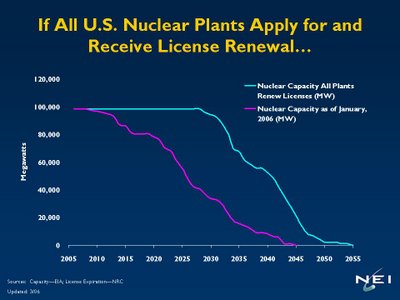 When a nuclear plant retires, the primary source of fuel for its replacement would be coal. A typical 1,000 MW nuclear plant consumes about 20 metric tons of uranium during its fuel cycle (18 or 24 months). A comparable coal plant would need about 3.43 million tons of coal each year to provide the same generation as a nuclear plant. And as we saw earlier this week, transporting large volumes of coal can present other challenges as well.
To replace the same generation with a natural gas plant, you'd need 65.8 billion cubic feet of gas, and for oil, 13.7 million barrels.
If you multiply these figures by 20 years you would need:
And then there's the question of carbon emissions. The average coal plant emits 2,217 pounds of CO2 per megawatt hour. The average oil plant emits 1,819 lbs / MWh and the average natural gas plant emits 1,115 lbs / MWh. The average nuclear reactor generates 7.9 million MWh each year. If a nuke plant were replaced by coal, there would be an additional 7.928 million metric tons of CO2 in the air each year. An oil plant would emit 6.5 million metric tons of CO2 and a natural gas plant would emit 4.0 million metric tons of CO2.
This is only one year and for one unit. I'll let you do the math for the additional twenty years and 103 nuclear reactors.
So the question is this: Would you rather have an additional 41,000 metric tons of used uranium fuel stored safely and securely in dry casks or more than 8,000,000,000 metric tons of CO2 injected into the atmosphere? The next time somebody asks you about the nuclear waste problem, be sure to mention those 8,000,000,000 additional metric tons of CO2.
Technorati tags: Nuclear Energy, Environment, Energy, Technology, Electricity, Natural Gas, Oil, Uranium, Climate Change, Greenhouse Gases
 When a nuclear plant retires, the primary source of fuel for its replacement would be coal. A typical 1,000 MW nuclear plant consumes about 20 metric tons of uranium during its fuel cycle (18 or 24 months). A comparable coal plant would need about 3.43 million tons of coal each year to provide the same generation as a nuclear plant. And as we saw earlier this week, transporting large volumes of coal can present other challenges as well.
To replace the same generation with a natural gas plant, you'd need 65.8 billion cubic feet of gas, and for oil, 13.7 million barrels.
If you multiply these figures by 20 years you would need:
68.6 million tons of coal; orThis is for one plant. If a nuclear reactor does not renew its license for another twenty years, the U.S. would need that much more coal or natural gas or oil to meet the same demand. Take these figures and multiply by the 103 nuclear units in the U.S. and you get:
1,316 billion cubic feet of gas; or
274 million barrels of oil
7,065 million tons of coal;The amount of uranium for the additional 20 years needed for the entire nuclear fleet would only be about 41,000 metric tons.
135,548 billion cubic feet of gas;
28,222 million barrels of oil.
And then there's the question of carbon emissions. The average coal plant emits 2,217 pounds of CO2 per megawatt hour. The average oil plant emits 1,819 lbs / MWh and the average natural gas plant emits 1,115 lbs / MWh. The average nuclear reactor generates 7.9 million MWh each year. If a nuke plant were replaced by coal, there would be an additional 7.928 million metric tons of CO2 in the air each year. An oil plant would emit 6.5 million metric tons of CO2 and a natural gas plant would emit 4.0 million metric tons of CO2.
This is only one year and for one unit. I'll let you do the math for the additional twenty years and 103 nuclear reactors.
So the question is this: Would you rather have an additional 41,000 metric tons of used uranium fuel stored safely and securely in dry casks or more than 8,000,000,000 metric tons of CO2 injected into the atmosphere? The next time somebody asks you about the nuclear waste problem, be sure to mention those 8,000,000,000 additional metric tons of CO2.
Technorati tags: Nuclear Energy, Environment, Energy, Technology, Electricity, Natural Gas, Oil, Uranium, Climate Change, Greenhouse Gases
Wednesday, 8 March 2006
Drinking Amory's Kool Aid
Environmental Action is drinking a type of Kool Aid only made in the Rocky Mountains. Here's Navin Nayak:
Rod Adams vs. Amory Lovins
Bad Data Leads to Bad Conclusions
More Bad Data from Amory Lovins
Revisiting RMI's Bad Data
Revisiting RMI and Amory Lovins
Doublechecking the Numbers
Checking the Data with Peter Asmus
Technorati tags: Nuclear Energy, Environment, Energy, Electricity, Carbon Emissions, Rocky Mountain Institute, Amory Lovins
I haven't heard much from this morning's committee hearing on energy independence, but I did track down Amory Lovin's press release for the event. As usual, his thoughts are bold and solidly backed by research.Carefully researched? I guess it depends on who you talk to. Take a look at the following links to see what we're talking about:
Rod Adams vs. Amory Lovins
Bad Data Leads to Bad Conclusions
More Bad Data from Amory Lovins
Revisiting RMI's Bad Data
Revisiting RMI and Amory Lovins
Doublechecking the Numbers
Checking the Data with Peter Asmus
Technorati tags: Nuclear Energy, Environment, Energy, Electricity, Carbon Emissions, Rocky Mountain Institute, Amory Lovins